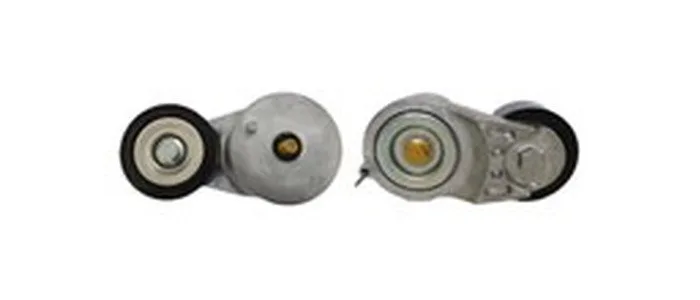
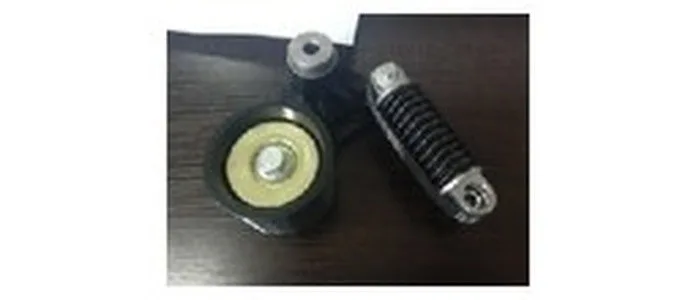
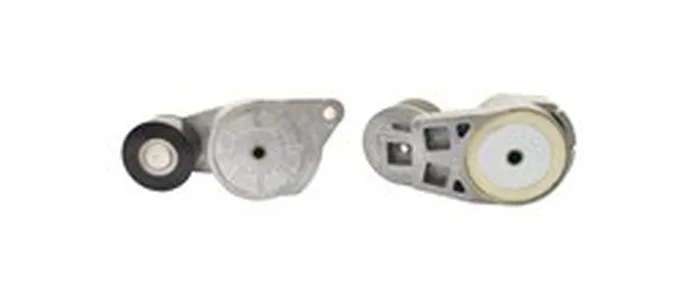
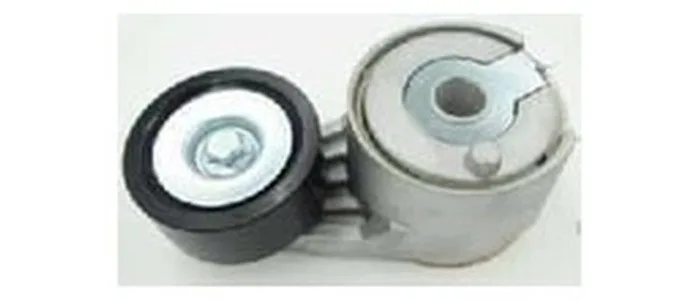
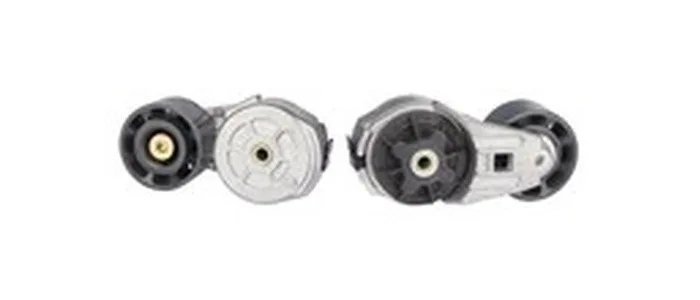
Choosing the correct heavy-duty truck belt tensioner or idler pulley is important for maintaining proper belt tension, alignment, and accessory drive performance.
A tensioner that looks similar may not necessarily be interchangeable. Differences in pulley diameter, belt profile, bearing size, mounting position, spring torque, arm geometry, and operating direction can affect whether the part will work correctly.
The following methods can help identify the correct replacement belt tensioner for a heavy-duty truck.
1. Start with the OE Part Number
The most reliable way to identify a replacement tensioner is to locate the original OEM or OE part number.
The OE number can often be found on:
- The original tensioner or pulley
- The vehicle parts catalogue
- The engine manufacturer's parts system
- Previous service records
- The original packaging or invoice
Once the OE number is identified, it can be cross-referenced with aftermarket manufacturers such as:
- Gates
- Dayco
- SKF
- INA
- Febi
- Litens
Professional aftermarket catalogues normally provide an OE-to-aftermarket cross-reference, allowing an OEM number to be matched with an equivalent replacement part.
For commercial trucks, it is also useful to confirm the truck make, model, engine model, and engine year, because the same vehicle model may use different belt drive systems depending on the engine configuration.
2. Use a Cross-Reference Chart
A belt tensioner cross-reference chart is one of the most useful tools for workshops, distributors, and parts buyers.
For example, an OE belt tensioner number may cross-reference to a Gates, Dayco, SKF, or another aftermarket part number.
A typical cross-reference may include:
- OE part number
- Aftermarket part number
- Engine manufacturer
- Engine model
- Vehicle manufacturer
- Vehicle model
- Application year
Whenever possible, the OE cross-reference should be the first method used before attempting to identify a tensioner by dimensions.
3. Check the Pulley Outside Diameter
If an exact cross-reference cannot be found, the pulley outside diameter (OD) is one of the first dimensions to check.
Heavy-duty truck tensioner and idler pulley diameters vary considerably depending on the engine and belt drive design.
The replacement pulley should closely match the original manufacturer's specification.
Do not assume that two tensioners are interchangeable simply because their pulley diameters are similar. Pulley diameter affects belt routing, belt contact, tensioner travel, and accessory drive geometry.
4. Identify the Pulley Surface: Smooth or Grooved
The pulley contact surface must match the side of the belt that runs across it.
Smooth Pulley
A smooth or backside pulley normally contacts the flat back surface of a multi-rib belt.
Grooved Pulley
A V-ribbed or grooved pulley contacts the ribbed side of the belt.
For grooved pulleys, the number of grooves must match the belt and application.
Common configurations may include:
- 6-rib
- 8-rib
- 10-rib
- 12-rib
The pulley groove profile, spacing, and width must correspond to the belt specification.
5. Measure Pulley Width
Pulley width is another important identification dimension.
Two pulleys may have the same outside diameter but different widths.
Check:
- Overall pulley width
- Belt contact width
- Position of the pulley relative to the tensioner arm
- Flange configuration, where applicable
Incorrect pulley width or offset can cause belt misalignment, edge wear, noise, or premature belt failure.
6. Check the Bearing Bore Diameter
The bearing bore or bearing inside diameter is an important specification when replacing an idler pulley or tensioner pulley.
Heavy-duty applications use several different bearing bore sizes.
For example, 17 mm bearing bores are common in many heavy-duty pulley applications, while 30 mm bores are also used on certain designs. Other applications may use 10 mm, 12 mm, 20 mm, or other sizes.
Therefore, the bore diameter should always be measured or confirmed from the manufacturer's specification rather than assumed from the pulley diameter.
7. Check the Bearing Design
Heavy-duty diesel engines place significant loads on accessory belt systems.
For this reason, many heavy-duty tensioners and pulleys use reinforced bearing designs such as:
- Double-row ball bearings
- Dual sealed bearings
- Permanently lubricated bearings
- High-load bearing configurations
The bearing specification should be suitable for the operating load, vibration, temperature, and service environment of the engine.
Bearing type is therefore an important consideration when comparing aftermarket tensioners.
8. Check Mounting Dimensions and Bolt Configuration
For a complete belt tensioner assembly, pulley dimensions alone are not sufficient.
The mounting system must also be checked carefully.
Important measurements include:
- Mounting hole diameter
- Bolt size
- Bolt spacing
- Mounting position
- Centre-to-centre dimensions
- Tensioner arm length
- Pulley offset
- Pivot location
Even a small difference in mounting geometry can change belt alignment or prevent installation.
9. Check Tensioner Arm Direction and Spring Torque
This is especially important for automatic belt tensioners.
Two tensioners can appear almost identical but still have different:
- Spring torque
- Tensioning force
- Arm travel
- Load direction
- Rotation direction
- Damping characteristics
Therefore, visual appearance and pulley size alone should never be used to confirm interchangeability between complete automatic tensioner assemblies.
If the spring force or tensioner geometry is incorrect, the belt may be either under-tensioned or over-tensioned.
This can result in:
- Belt slip
- Belt noise
- Excessive vibration
- Premature belt wear
- Bearing damage
- Alternator charging problems
- Reduced water pump or fan performance
10. Confirm the Engine Application
Before ordering a heavy-duty belt tensioner, always confirm the engine application.
Useful information includes:
Truck Make:
Kenworth, Peterbilt, Freightliner, International, Volvo, Mack, Western Star, Scania, MAN, DAF, Mercedes-Benz, Iveco, etc.
Engine Manufacturer:
Cummins, Caterpillar, Detroit Diesel, PACCAR, Volvo, Mack, Mercedes-Benz, Scania, etc.
Engine Model:
For example:
- Cummins ISX15
- Cummins X15
- Detroit DD15
- Volvo D13
- PACCAR MX-13
- Caterpillar C15
Vehicle Year
OE Part Number
Providing this information significantly reduces the risk of ordering the wrong tensioner.
What Information Should You Provide When You Cannot Find the Part Number?
If the OE number is missing or unreadable, provide as much of the following information as possible:
- Truck make and model
- Vehicle year
- Engine manufacturer
- Engine model
- Engine serial number, if available
- Photos of the original tensioner
- Pulley outside diameter
- Pulley width
- Smooth or grooved pulley
- Number of grooves
- Bearing bore diameter
- Mounting hole dimensions
- Centre-to-centre mounting dimensions
- Tensioner arm length
- Pulley offset
Photos should ideally show the tensioner from the front, rear, and side, together with any visible numbers or markings.
OE Number First, Dimensions Second
For heavy-duty truck belt tensioners, the safest identification sequence is:
OE Part Number → Engine Application → Cross-Reference → Physical Dimensions → Final Verification
Physical dimensions are particularly useful when identifying an unknown pulley, but dimensions alone should not be used to confirm that two complete automatic tensioners are interchangeable.
The correct tensioner must match both the physical installation and the operating characteristics of the belt drive system.
Need Help Identifying a Heavy-Duty Belt Tensioner?
If you cannot identify your existing belt tensioner, send us:
- OE number
- Truck model
- Engine model
- Vehicle year
- Photos of the original part
- Key dimensions
Our team can help cross-reference the application and identify a suitable replacement tensioner or pulley.