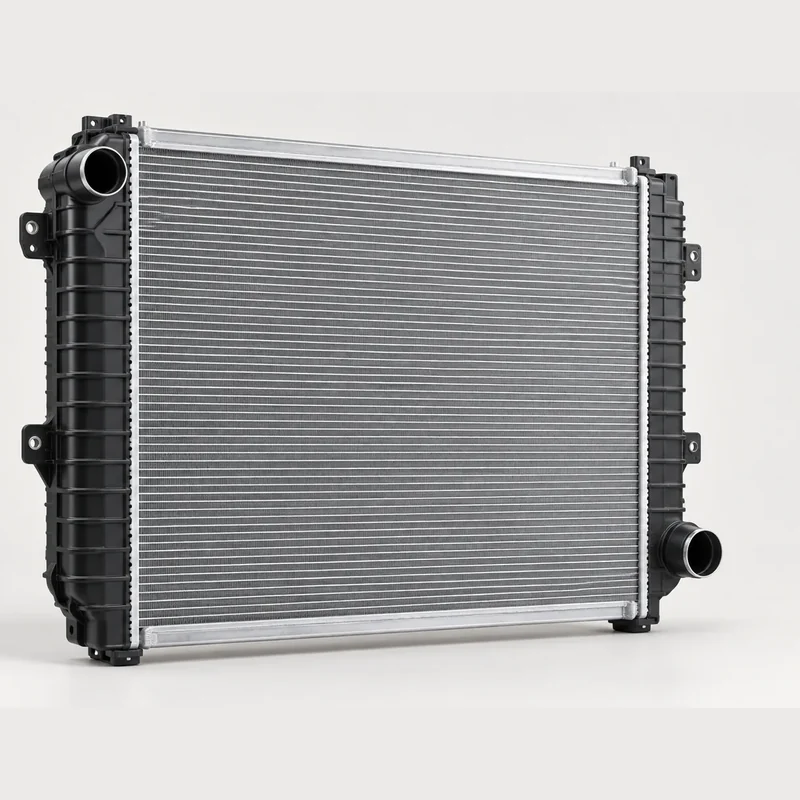
The radiator is one of the most critical components in a heavy-duty truck cooling system.
A leaking, blocked, damaged, or inefficient radiator can cause the engine to operate at excessive temperatures. If the problem is not identified in time, prolonged overheating may lead to serious engine damage, including cylinder head or gasket failure, piston or liner damage, and in extreme cases engine seizure.
Heavy-duty truck radiator failures can generally be divided into four major categories:
- Mechanical and thermal stress
- Chemical and electrochemical corrosion
- Material or manufacturing defects
- Incorrect operation and maintenance
Understanding the failure pattern can help determine whether the radiator itself is defective or whether another cooling-system problem caused the radiator to fail.
1. Vibration and Thermal Fatigue Cracking
Vibration and thermal cycling are among the most important causes of radiator fatigue in heavy-duty vehicles.
Truck radiators operate in an environment with continuous chassis vibration while repeatedly heating and cooling during engine operation.
Over time, these repeated mechanical and thermal loads can produce fatigue cracks.
Typical Failure Signs
Common damage includes:
- Cracks where radiator tubes join the header plate
- Cracks around tube-to-header joints
- Leaks around tank-to-core connections
- Cracked side plates or mounting brackets
- Failure around welded or brazed joints
Possible Causes
Excessive Mechanical Vibration
Worn, hardened, damaged, or incorrectly installed radiator mounting cushions can reduce vibration isolation.
As a result, vibration from the chassis, engine, or road may be transmitted directly into the radiator assembly.
Repeated loading can eventually cause fatigue cracking.
Thermal Stress
Radiator components continuously expand and contract as coolant temperature changes.
Differences in temperature and thermal expansion between the tubes, header plates, tanks, and structural components can create localized stresses.
Repeated thermal cycling may eventually initiate fatigue cracks, particularly around joints and other stress concentration areas.
2. Internal and External Corrosion
Modern truck radiators typically use thin-wall aluminum construction, although copper-brass radiators are still found in some applications.
Because radiator tubes are relatively thin, corrosion can eventually result in perforation and coolant leakage.
Typical Failure Signs
- Small pinhole leaks
- Localized tube perforation
- Internal deposits
- Corroded tanks or connections
- Deteriorated radiator fins
- Reduced cooling efficiency
Internal Corrosion
One common cause is incorrect coolant or poor coolant maintenance.
Using untreated tap water or mineral-rich well water for extended periods can introduce minerals and corrosive ions into the cooling system.
High concentrations of chlorides, sulfates, calcium, and magnesium may contribute to:
- Corrosion
- Pitting
- Scale formation
- Restricted coolant flow
- Reduced heat transfer
The correct coolant and water quality should always meet the engine manufacturer's specification.
External Corrosion
The radiator is installed directly in the vehicle's front airflow and is therefore exposed to the road environment.
External corrosion can be accelerated by:
- Road salt
- De-icing chemicals
- Coastal salt spray
- Mud
- Moisture
- Industrial contaminants
Salt and moisture remaining on the radiator surface can accelerate corrosion of aluminum fins, tubes, and other metal components.
Galvanic and Electrochemical Corrosion
A cooling system contains several different metals, which may include aluminum, cast iron, steel, copper, and brass.
Correctly formulated coolant contains corrosion inhibitors designed to protect these materials.
If coolant is severely degraded, contaminated, incorrectly mixed, or incompatible with the engine manufacturer's specification, corrosion protection may be reduced.
This can accelerate electrochemical attack within the cooling system.
3. Stone Impact and External Mechanical Damage
Heavy-duty trucks frequently operate in harsh environments.
Construction trucks, mining trucks, dump trucks, and off-road vehicles may be exposed to stones, gravel, dust, and debris.
Typical Failure Signs
- Bent radiator fins
- Damaged front surface
- Crushed cooling passages
- Punctured radiator tubes
- Localized coolant leakage
Stone and Gravel Impact
Road debris can strike the radiator core at relatively high speed.
Repeated impact may flatten cooling fins or, in severe cases, damage the coolant tubes.
Bent fins reduce airflow through the radiator and therefore reduce heat-transfer efficiency.
Airflow Restriction
Mud, insects, dust, grass, and other debris can accumulate on the radiator face.
Even when the radiator does not leak, restricted airflow may significantly reduce cooling capacity and cause higher engine temperatures.
4. Internal Deposits and Restricted Coolant Flow
Radiator failure does not always mean that the radiator is leaking.
Internal contamination can gradually block radiator tubes and reduce coolant circulation.
Possible contaminants include:
- Mineral deposits
- Scale
- Rust particles
- Coolant degradation products
- Oil contamination
- Incorrect sealing additives
- Foreign material remaining after cooling-system repairs
Typical Symptoms
- Engine running hotter than normal
- Overheating under heavy load
- Radiator fan operating frequently
- Uneven radiator temperature
- Large temperature differences across different parts of the core
Restricted coolant flow reduces the radiator's ability to transfer engine heat to the surrounding air.
5. Coolant Erosion, Aeration and Cavitation-Related Damage
Air trapped or continuously introduced into the cooling system can reduce cooling efficiency and may contribute to erosion or cavitation-related damage in some areas of the cooling circuit.
High coolant velocity, aeration, or abnormal pressure conditions may gradually damage metal surfaces.
Possible contributing factors include:
- Incorrect system bleeding
- Low coolant level
- Air entering through leaking hoses or connections
- Water pump problems
- Abnormal coolant circulation
If erosion-type damage is found, the complete cooling system should be investigated rather than simply replacing the radiator.
6. Excessive Cooling-System Pressure
The cooling system operates under controlled pressure.
The pressure cap or expansion-tank cap allows the system to operate at the pressure specified by the vehicle or engine manufacturer.
Excessive pressure can damage radiator tubes, tanks, seals, and connections.
Typical Failure Signs
- Expanded or distorted radiator tubes
- Cracked plastic tanks
- Tank-to-core separation
- Coolant pushed out of the expansion tank
- Repeated radiator leakage
- Swollen coolant hoses
Faulty Pressure Cap
If the pressure-relief valve in the radiator or expansion-tank cap does not operate correctly, system pressure may rise beyond the intended operating range.
Radiator cap pressure varies by vehicle and engine application, so the correct OEM-specified pressure rating must always be used.
Combustion Gas Entering the Cooling System
Excessive cooling-system pressure is not always caused by the radiator.
A damaged cylinder-head gasket, cracked cylinder head, or other combustion-chamber leak can allow high-pressure combustion gas to enter the cooling system.
Possible symptoms include:
- Rapid pressure build-up after cold start
- Coolant being forced from the expansion tank
- Continuous bubbles in the coolant reservoir
- Repeated hose swelling
- Unexplained coolant loss
If a replacement radiator repeatedly fails from excessive pressure, the engine should be checked before another radiator is installed.
Heavy-Duty Radiator Failure Diagnosis
A systematic inspection can help determine the actual cause of radiator failure.
| Diagnostic Step | Area to Check | Typical Finding | Possible Cause |
| Visual Inspection | Radiator face, side plates and mounts | Bent fins, broken brackets, damaged mounts | Stone impact, excessive vibration |
| Cooling-System Pressure Test | Radiator, tanks and connections | Coolant leakage or pressure loss | Cracked tube, joint failure, damaged tank |
| Radiator Leak Test | Core and tube/header joints | Air bubbles from specific area | Fatigue crack, corrosion or manufacturing defect |
| Internal Inspection | Coolant passages and tanks | Scale, sediment or contamination | Poor coolant, unsuitable water, cooling-system contamination |
| Temperature Test | Radiator inlet, outlet and core | Abnormal or uneven temperature distribution | Restricted flow or internal blockage |
| Coolant Inspection | Expansion tank or drained coolant | Rust, oil, deposits or contamination | Corrosion, engine problem or degraded coolant |
| Failure-Surface Examination | Crack or perforation | Pitting or fatigue pattern | Corrosion or cyclic stress |
For complex or repeated failures, microscopic inspection, coolant analysis, pressure testing, or combustion-gas testing may be required.
How to Prevent Heavy-Duty Radiator Failure
1. Use the Correct Heavy-Duty Coolant
Always use coolant that meets the specification of the engine or vehicle manufacturer.
Do not assume that one coolant technology is suitable for every truck.
Depending on the engine, the specified coolant may use:
- OAT
- Hybrid OAT
- Fully formulated conventional technology
- Other OEM-specific coolant chemistry
If concentrate is used, mix it only with water that meets the manufacturer's water-quality requirements.
Repeatedly topping up the cooling system with ordinary tap or well water can dilute corrosion inhibitors and introduce minerals into the system.
2. Do Not Select Coolant by Colour Alone
Coolant colour is not a reliable technical specification.
Two coolants with similar colours may use different additive packages, while compatible products may have different colours.
Coolant should therefore be selected according to:
- OEM specification
- Coolant chemistry
- Product approval
- Manufacturer compatibility requirements
Avoid mixing different coolant chemistries unless compatibility has been confirmed.
3. Inspect Radiator Mounting Cushions
Radiator rubber mounts and isolators should be inspected for:
- Hardening
- Cracking
- Compression
- Looseness
- Separation
- Incorrect installation
Damaged mounting cushions should be replaced before they allow excessive chassis vibration to reach the radiator.
4. Protect Radiators in Severe Operating Environments
Vehicles operating in mines, construction sites, gravel roads, or other severe environments may benefit from suitable radiator protection screens.
However, any protective screen must allow sufficient airflow.
A screen that is too restrictive can reduce cooling performance.
5. Keep the Radiator Core Clean
Dust, insects, mud, and debris should be removed before they significantly restrict airflow.
Use reduced-pressure compressed air or an appropriate low-pressure water jet.
Avoid placing a high-pressure washer close to the radiator core because the thin aluminum fins can easily bend.
Where water cleaning is used, direct the flow carefully through the fin passages rather than across them at a sharp angle.
6. Check the Pressure Cap
The radiator or expansion-tank cap should be inspected and replaced according to the manufacturer's maintenance requirements.
Always use the correct pressure rating for the specific vehicle application.
7. Investigate the Root Cause Before Replacing the Radiator
When a radiator fails, replacing the radiator without identifying the underlying problem may result in another failure.
Before installation of a replacement radiator, check:
- Coolant condition
- System pressure
- Pressure cap
- Radiator mounts
- Water pump
- Thermostat
- Cooling fan
- Hoses
- Expansion tank
- Possible combustion-gas leakage
- Cooling-system contamination
A radiator failure can sometimes be the symptom of another cooling-system or engine problem rather than the original cause.
Repeated Radiator Failure? Check the Whole Cooling System
If a heavy-duty truck radiator repeatedly cracks, leaks, corrodes, or becomes blocked, the radiator itself should not automatically be blamed.
The failure pattern can provide important information:
Tube-to-header cracking
→ Check vibration, mounting cushions and thermal fatigue.
Pinhole corrosion
→ Check coolant chemistry, water quality and contamination.
Bent fins or punctured tubes
→ Check stone impact and operating environment.
Expanded tubes or cracked tanks
→ Check cooling-system pressure and combustion-gas leakage.
Internal scale or blockage
→ Check coolant maintenance and water quality.
Correct root-cause diagnosis can prevent repeated radiator replacement and reduce expensive engine downtime.
Need Help Identifying a Replacement Heavy-Duty Radiator?
When requesting a replacement radiator, provide as much information as possible:
- Truck make and model
- Vehicle year
- Engine make and model
- OE radiator number
- Radiator dimensions
- Inlet and outlet positions
- Photos of the original radiator
- Details of the radiator failure
This information can help confirm the correct replacement radiator and identify possible causes of premature failure.
 SERIES IMAGE