The charge-air cooler (CAC), often called the intercooler, is a key part of the air intake system on every modern turbocharged heavy-duty diesel engine.
When a charge-air cooler leaks, becomes blocked, or loses cooling efficiency, the engine receives less air, and that air is hotter than it should be. The result is usually lower power, higher fuel consumption, higher exhaust temperatures and, over time, additional stress on the turbocharger, pistons, valves and aftertreatment system.
This guide covers how a CAC works, why it fails, the symptoms, how to pressure-test it, and how to identify the correct replacement.
How a Charge-Air Cooler Works on a Turbocharged Diesel
The turbocharger compresses intake air before it enters the engine. Compressing air raises its pressure, but it also raises its temperature considerably.
Hot air is less dense, so each cylinder fill contains less oxygen. This limits how much fuel can be burned cleanly and raises combustion temperatures.
The charge-air cooler solves this problem. It is an air-to-air heat exchanger, normally mounted in front of the engine radiator:
- Hot, pressurised air leaves the turbocharger compressor.
- It travels through the hot-side pipe and hoses to the CAC inlet tank.
- The air passes through the CAC core tubes, where ambient air flowing across the fins removes heat.
- Cooled, denser air leaves the outlet tank and travels through the cold-side pipe and hoses to the intake manifold.
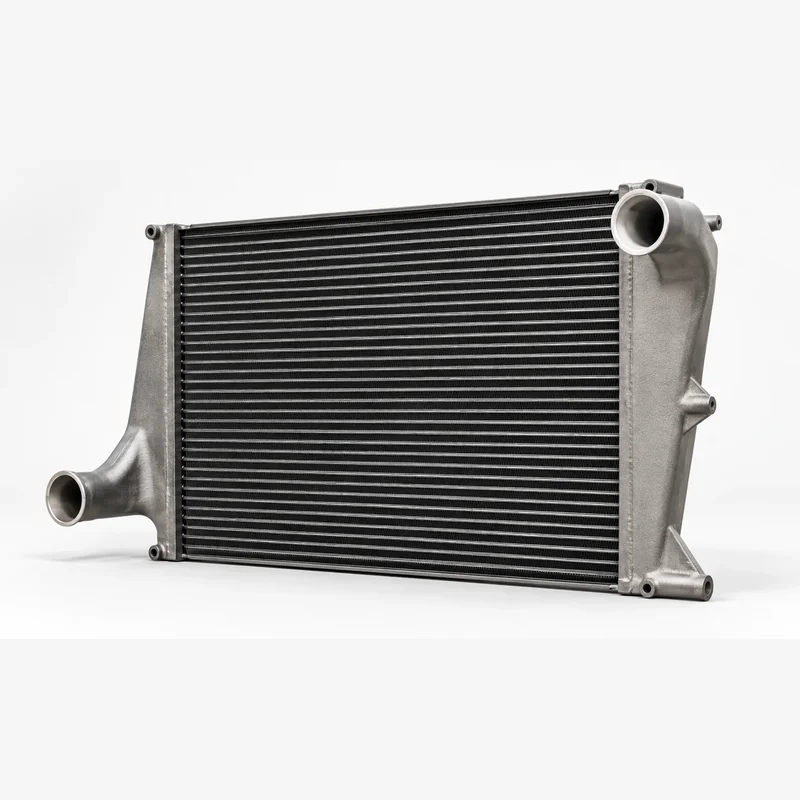
Most heavy-duty truck CACs are aluminium assemblies made of a core (tubes and fins, or bar-and-plate construction) brazed to header plates, with an inlet and outlet tank on each side. Because the CAC sits between the turbo and the engine, the entire assembly operates under boost pressure.
Common Causes of Charge-Air Cooler Failure
A failed CAC is often the result of its operating conditions rather than a defect in the part itself.
1. Thermal and Pressure Cycling Fatigue
Every time the engine goes from idle to full load, the CAC is heated by hot boost air and pressurised; when load drops, it cools and pressure falls.
The inlet side of the core runs much hotter than the outlet side, so different areas of the core expand by different amounts. Over hundreds of thousands of cycles, this repeated expansion, contraction and pressure loading concentrates stress at the tube-to-header joints and tank welds.
Typical result: fine cracks at the ends of the tubes, most often on the hot (inlet) side, causing a boost leak.
2. Vibration and Mounting Problems
The CAC is part of the cooling module and is exposed to continuous chassis and engine vibration.
Worn or missing rubber isolators, broken brackets, loose mounting bolts, or a cooling module that is not correctly supported can transfer vibration and frame twist into the CAC. This accelerates cracking at tank seams, side plates and tube joints.
3. Hose and Clamp Failures
Many "intercooler leaks" are actually leaks in the connections. The charge-air hoses and clamps are exposed to heat, oil vapour, boost pressure and engine movement.
Common problems include:
- Split, softened or delaminated silicone hoses
- Hoses rubbing against brackets or other components
- Loose, over-tightened or broken clamps
- Hoses blown off a pipe end
- Cracked or dented charge-air pipes
A sudden "pop" followed by loss of power is a typical sign that a hose or clamp has failed.
4. Internal Oil Contamination from the Turbocharger
Some oil mist in the charge-air system can be normal, especially with crankcase ventilation routed to the compressor inlet. Large amounts of oil are not.
Worn turbocharger seals or bearings, a restricted turbo oil drain, high crankcase pressure, or a restricted air filter can push oil into the CAC. Oil coats the inside of the tubes, collects soot and dirt, and reduces heat transfer. As industry sources reported by CCJ note, turbo oil seepage can lead to soot build-up that clogs the cooler from the inside.
If a CAC is replaced because of oil contamination, the source of the oil must be fixed first, or the new cooler will be contaminated too.
5. External Damage, Debris and Corrosion
As the front-most heat exchanger, the CAC takes the first impact from stones, gravel and road debris.
- Stone impact can bend fins or puncture tubes.
- Road salt and de-icing chemicals accelerate corrosion of aluminium fins and tubes.
- Coastal and industrial environments also increase external corrosion.
Corrosion may first appear as white powdery deposits on the fins and tubes, and can eventually perforate the thin tube walls.
6. Plugged or Damaged Fins
Insects, dust, leaves, chaff and mud collect on the CAC face. Because the CAC is in front of the radiator, a blocked CAC reduces airflow for both heat exchangers.
A plugged CAC may not leak at all, but it will deliver hotter intake air and can contribute to higher coolant temperatures.
Symptoms of a Failing Intercooler or Charge-Air Cooler
CAC problems usually develop gradually. Common symptoms include:
- Loss of power, especially on hills or under heavy load
- Black smoke during acceleration, because there is less air for the fuel being injected
- Higher exhaust gas temperature (EGT) and, in some cases, higher coolant temperature
- Boost-related fault codes, such as low boost pressure, high intake manifold temperature, or EGR/airflow plausibility codes
- Hissing or whistling under boost from a cracked core or loose connection
- Oil residue around hose connections, tank seams or on the CAC face
- Higher fuel consumption with no other obvious cause
- More frequent DPF regeneration due to increased soot production
Because boost leaks also affect combustion, a long-term leak can contribute to extra soot in the engine oil and higher thermal load on engine components. Fleet Equipment lists loss of power, increased fuel consumption and elevated soot levels in engine oil among the typical consequences of a leaking cooler.
Many of these symptoms can also come from a faulty turbo, restricted air filter, exhaust leak, EGR fault or sensor, so test the CAC rather than assume it is the cause.
How to Diagnose a Charge-Air Cooler Leak
A systematic diagnosis avoids replacing a good CAC when the real problem is elsewhere.
Step 1: Read Fault Codes and Live Data
Connect a diagnostic tool and check for boost, intake temperature and airflow codes. Compare actual boost pressure and intake manifold temperature with the expected values under load, according to the engine manufacturer's service information.
Step 2: Visual Inspection
With the engine off and cool, inspect:
- All charge-air hoses, pipes and clamps
- Oily or dirty streaks around joints, tank seams and tube ends
- Bent fins, punctured tubes and debris build-up on the CAC face
- Mounting brackets, isolators and fasteners
- Turbocharger compressor inlet and outlet for oil
Step 3: Perform a CAC Pressure (Air-Decay) Test
The most reliable way to confirm a CAC leak is a pressure-decay test using a CAC test kit with plugs, a pressure regulator, a gauge and a shut-off valve. The general procedure is:
- Disconnect the hoses from the turbocharger outlet and the intake manifold, leaving the CAC installed (or test it on the bench).
- Install the test plugs in both the inlet and outlet and clamp them securely.
- Connect regulated shop air and slowly pressurise to the test pressure specified by the engine or truck manufacturer.
- Close the supply valve and time the pressure drop on the gauge.
- Spray soapy water on the core, tanks and joints to locate the leak.
- If the result is borderline, re-check the plugs and clamps and repeat the test to confirm a consistent reading.
- Release the pressure slowly before removing the test equipment.
As an example of an OEM limit, a Navistar service procedure for several International truck models (published via NHTSA) specifies pressurising the CAC to 30 psi and states that pressure should not drop more than 5 psi in 15 seconds. The same document notes that charge-air coolers are not designed to be 100% airtight, so a small, in-specification pressure drop does not mean the CAC needs replacing.
Other manufacturers and engines use different test pressures, time periods and allowable drops. Always use the values in the service information for the specific engine and vehicle.
Safety note: Never exceed the specified test pressure, and make sure plugs are fully secured. A plug released under pressure can cause serious injury.
Step 4: Check for Internal Restriction
A CAC can pass a leak test and still perform poorly. Heavy oil contamination or internal blockage may show up as a high temperature or pressure difference across the cooler under load. Compare readings with the manufacturer's specification where available.
Repair or Replace?
For heavy-duty CACs, replacement is usually the practical choice once the core itself is leaking.
- Hoses, clamps and pipes should be repaired or replaced; these are normal service items.
- Bent fins can sometimes be carefully straightened if the tubes are not damaged.
- Core cracks at tube-to-header joints are difficult to repair reliably, because the area is under repeated thermal and pressure cycling. Some OEM service information specifically advises against attempting field repair of the CAC.
- Oil contamination may be cleaned in some cases according to the manufacturer's procedure, but severe contamination or turbo debris usually means replacement.
Before installing a new CAC, fix the root cause: replace worn isolators and brackets, renew damaged hoses and clamps, and repair any turbocharger or crankcase ventilation problem.
How to Identify the Correct Replacement Charge-Air Cooler
Many heavy-duty CACs look similar, but small differences can prevent installation or affect performance.
1. Start with the OE Part Number
The OE part number is the most reliable identifier. It may be found on a label or stamping on the tank or side plate, in the vehicle parts catalogue, or in previous service records.
2. Confirm the Truck and Engine Application
Record the truck make, model and year, together with the engine make and model. The same truck model may use different CACs depending on engine, cab, hood or cooling package.
3. Measure the Core Dimensions
Measure the core height, width and thickness (depth), plus the overall dimensions including tanks.
4. Check Inlet and Outlet Diameter and Position
Confirm the outside diameter of the inlet and outlet connections, which side they are on, whether they point up, down or sideways, and their position relative to the core.
5. Compare Mounting Brackets and Features
Check the number, position and type of brackets, pins, studs and isolator locations, plus any sensor ports.
6. Use a Cross-Reference
Once the OE number is known, use a cross-reference to match it with an equivalent aftermarket part number, then verify the key dimensions before ordering.
The safest sequence is: OE number → truck/engine application → cross-reference → dimensions → final check.
How to Prevent Charge-Air Cooler Failure
- Inspect the CAC and charge-air hoses at every PM service for cracks, oil residue, rubbing and loose clamps.
- Use the correct clamps and torque specified by the manufacturer; do not over-tighten.
- Keep the CAC face clean, using low-pressure water or compressed air directed through the fins, ideally from the engine side.
- Replace worn isolators and broken brackets promptly.
- Fix turbocharger oil leaks and crankcase ventilation problems before they contaminate the CAC.
- Maintain the air filter to avoid high intake restriction and dust ingestion.
- Use suitable debris protection in severe service, without restricting airflow.
Frequently Asked Questions
What is the difference between an intercooler and a charge-air cooler?
On heavy-duty trucks the two terms usually mean the same part: an air-to-air heat exchanger that cools the compressed air from the turbocharger before it enters the intake manifold.
Can I drive a truck with a leaking charge-air cooler?
A truck may still run with a small leak, but it will usually lose power, use more fuel and run higher exhaust temperatures, so the leak should be diagnosed and repaired as soon as possible to avoid further engine and aftertreatment problems.
Is some leakage normal during a CAC pressure test?
Yes, some OEMs state that charge-air coolers are not 100% airtight and allow a specified pressure drop over a set time, so the result should be compared with the manufacturer's limit for that engine and vehicle.
Why is there oil in my charge-air cooler?
A light oil film can occur from crankcase ventilation, but heavy oil usually points to turbocharger seal wear, a restricted turbo oil drain, high crankcase pressure or high intake restriction, which should be fixed before installing a new CAC.
Where do heavy-duty charge-air coolers usually crack?
Cracks most often appear at the tube-to-header joints and around the tanks, particularly on the hot inlet side, where thermal and pressure cycling stress is highest.
What information do I need to order a replacement CAC?
The OE part number is best; otherwise provide the truck make, model and year, engine model, core dimensions, inlet and outlet sizes and positions, and clear photos of the old cooler.
Need a Replacement Charge-Air Cooler?
TRUPA supplies OE-referenced replacement charge-air coolers (intercoolers) for heavy-duty trucks to importers, distributors and workshops.
Send us the OE number, the truck model and year, or a photo of the old part, and our team will help confirm the correct replacement.
 SERIES IMAGE