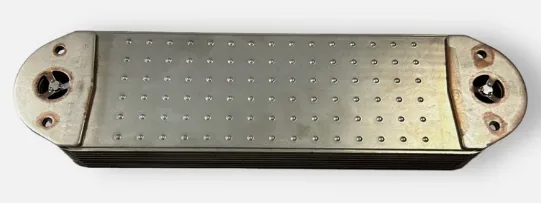
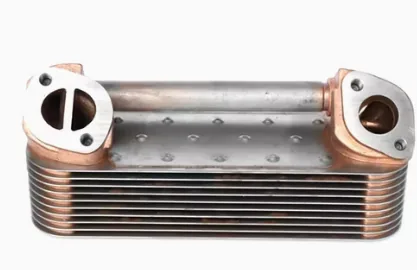
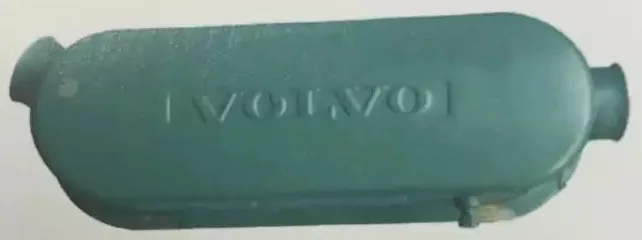
The engine oil cooler is a small component with a big job. It keeps lubricating oil within its correct temperature range by transferring heat from the oil into the engine coolant.
A leaking oil cooler can cause oil in the coolant, coolant in the oil, milky oil, high oil temperature or low oil pressure. If coolant reaches the bearings, the result can be a major engine failure.
How an Engine Oil Cooler Works
Most heavy-duty diesel engines use a liquid-to-liquid oil cooler. Hot oil from the oil pump passes through the cooler, while engine coolant flows around or between the oil passages and carries the heat away to the radiator.
Plate-Type and Tube-Type Cores
Many modern truck engines use a plate-type (stacked plate) core. Pairs of thin, brazed plates form oil passages, with coolant flowing between them. Some older and off-highway engines use tube-type cores instead.
Housing, Gaskets and Seals
The core is usually mounted in an oil cooler housing or cover bolted to the side of the engine block. The housing contains the oil and coolant passages, and on many engines also carries the oil filter head.
The joints between core, housing and block are sealed with gaskets and O-rings. These seals are as important as the core itself: a failed seal can mix fluids in the same way as a cracked plate.
Thermostatic Bypass Valve
Many engines have an oil thermostat or bypass valve in the housing or filter head. When the oil is cold, it bypasses the cooler so the engine warms up faster. When oil reaches operating temperature, the valve directs oil through the core.
Common Causes of Oil Cooler Failure
Oil cooler failures usually start from the coolant side, the oil side, or the seals. Identifying which one caused the failure is important, because a new cooler installed in an engine with the same underlying problem will often fail again.
1. Coolant Chemistry, Corrosion and Electrolysis
The coolant side of the core depends on correctly maintained coolant for corrosion protection.
Problems include:
- Depleted corrosion inhibitors or supplemental coolant additives (SCA)
- Coolant pH that has become too acidic
- Hard or untreated water used for mixing or top-up
- Stray electrical current in the coolant from poor chassis or engine grounds (electrolysis)
These conditions cause pitting and pinholes in the thin plates or tubes. Once a plate is perforated, oil and coolant can mix.
2. Cavitation Erosion
Cavitation occurs when tiny vapour bubbles collapse against metal surfaces. In diesel engines it is best known for pitting cylinder liners, but it can also attack other cooling-system components.
Low coolant level, low system pressure from a faulty radiator cap, and low nitrite levels in conventional coolants all increase the risk. According to this cooling system maintenance article from ForConstructionPros, nitrite is the main additive that protects against liner pitting and cavitation in conventional coolant, and SCA levels must be maintained.
3. Internal Plate Rupture from Pressure Spikes
Oil pressure on a cold start can be much higher than normal operating pressure, especially with thick oil in cold weather. A stuck oil pressure regulator can push it higher still, and repeated spikes can split plate seams or brazed joints.
4. Debris After an Engine Failure
When a bearing, piston or turbocharger fails, metal particles and sludge circulate through the lubrication system. The oil cooler core is one of the first components they reach after the pump.
The fine internal passages of a plate core are very difficult to clean completely. Debris left inside can restrict oil flow, raise oil temperature, and later be released into a freshly rebuilt engine.
For this reason, many rebuilders treat the oil cooler as a replace, not reuse item after a bearing or other major internal failure.
5. Gasket and O-Ring Failure
Gaskets and O-rings harden and shrink with age and heat. Incorrect torque, reused seals, damaged sealing faces or the wrong seal material can lead to leaks.
A housing seal leak may appear as an external leak of oil or coolant, or as an internal crossover between passages, depending on where the seal sits.
6. Overheating
Engine overheating raises the temperature and pressure in both systems.
7. Wrong Coolant or Mixed Coolants
Mixing incompatible coolant types, or adding SCA to a coolant that does not require it, can upset the inhibitor balance. Over-concentrated SCA can also form deposits that reduce heat transfer.
Symptoms of a Failed Oil Cooler
The symptoms depend on which way the fluids are moving. On a running engine, oil pressure is normally higher than coolant pressure, so an internal leak usually pushes oil into the coolant. After shutdown, when oil pressure drops and the cooling system is still pressurised, coolant can migrate into the oil.
Oil in Coolant
- Oil film or a brown, greasy layer in the expansion tank
- Thick, "chocolate milk" sludge in the coolant
- Oil-coated radiator cap and hoses
Coolant in Oil
- Milky, grey or tan oil on the dipstick or under the oil fill cap
- Oil level rising between changes
- Unexplained coolant loss with no external leak
- Oil analysis showing glycol, sodium or potassium
High Oil Temperature
Can be caused by a restricted core (debris or sludge on the oil side), scale or oil fouling on the coolant side, a bypass valve stuck open, or a general cooling-system problem.
Low Oil Pressure
A heavily restricted cooler, oil thinned by high temperature, or oil degraded by coolant contamination can all reduce oil pressure.
How to Diagnose an Oil Cooler Leak
Oil in the coolant or coolant in the oil does not automatically mean the oil cooler has failed. Other components can produce the same symptoms, so confirm the source before replacing parts.
Step 1: Confirm the Contamination with Fluid Analysis
Send oil and coolant samples to a laboratory. In oil, glycol, sodium, potassium and water are the key indicators of coolant contamination. Machinery Lubrication notes that potassium in oil almost always comes from glycol contamination, while FTIR alone cannot detect glycol below about 1,000 ppm.
Step 2: Rule Out Other Sources
Other common causes of oil and coolant mixing include:
- Cylinder head gasket failure
- Cracked cylinder head or block
- Leaking cylinder liner seals (wet-liner engines)
- Leaking injector sleeves or cups
- EGR cooler failure (usually coolant loss into the exhaust or intake rather than into the oil)
Combustion gas in the coolant, white exhaust smoke or coolant loss with no oil contamination point more towards the head gasket, head, injector sleeves or EGR cooler.
Step 3: Pressure Test the Cooling System
Pressurise the cooling system to the OEM-specified test pressure and monitor for pressure loss. Watch for coolant appearing in the oil pan or at the oil filter head.
A Detroit Diesel service bulletin on coolant in engine oil follows this approach: pressurise the cooling system, remove the oil pan to locate where coolant enters the oil (piston and liner area, liner-to-block interface, or gear train and oil return passages), and pressure test the oil cooler when coolant appears from the gear train or oil return passage.
Step 4: Pressure Test the Oil Cooler Core
Remove the core and test it on the bench:
- Clean the core and sealing faces.
- Fit blanking plates and gaskets to the oil passages.
- Apply regulated, low-pressure air to the oil side at the pressure specified in the engine service manual. Never apply unregulated shop air, which can damage a good core.
- Submerge the core in clean water, or apply soapy water, and turn it to release trapped air.
- A steady stream of bubbles from the coolant side confirms an internal leak.
Step 5: Inspect the Housing and Bypass Valve
Check the housing for cracks, corrosion and damaged sealing faces. Test the oil thermostat or bypass valve if high oil temperature was a symptom.
What to Do After an Oil Cooler Failure
Replacing the cooler is only part of the repair. Both systems must be cleaned, or the remaining contamination will damage the new parts.
Cooling System
- Drain the coolant completely, including the block drains if fitted.
- Flush with a cleaner designed to remove oil from cooling systems, following the cleaner manufacturer's and engine OEM's instructions. For example, an International Trucks radiator service bulletin lists Fleetguard Restore Plus (an acid-type cleaner) for removing scale, corrosion and oil fouling.
- Rinse with clean water until no oil residue remains.
- Replace the coolant filter (if fitted), radiator cap and any hoses that are oil-swollen or soft.
- Refill with new coolant of the correct type and concentration.
Lubrication System
- Drain the oil and replace all oil filters.
- If coolant has been in the oil, flush the lubrication system as the OEM recommends and change the oil again after a short run.
Bearings and Engine Internals
Coolant in oil turns the oil milky and promotes sludge, which can block filters and starve the bearings. The Filter Manufacturers Council bulletin on coolant leaks into engine oil warns that this can cause excessive wear and bearing failure.
If coolant reached the oil, inspect the main and rod bearings. Detroit's bulletin requires replacing the lower-end bearing kit, flushing the cooling system and changing the oil when coolant contamination is confirmed. Always follow the procedure for the specific engine.
After a Major Engine Failure
If the oil cooler was exposed to metal debris from a bearing, piston or turbo failure, replacing the core is generally safer than trying to clean it.
How to Identify the Correct Replacement Oil Cooler
1. OE Part Number
The OE part number is the most reliable identifier. It is usually stamped or tagged on the core or cast into the housing.
2. Engine Model and Serial Number
Confirm the engine manufacturer, model and engine serial number (ESN). Different production years of the same model can use different coolers.
3. Core or Housing?
Decide whether you need:
- The core only (plate stack), when the housing is in good condition
- The housing or cover, when it is cracked, corroded or the sealing faces are damaged
- A complete assembly (housing and core)
4. Plate Count and Core Dimensions
For plate-type cores, check the number of plates, the overall core length, width and thickness, and the position and size of the inlet and outlet ports. A core with fewer plates may fit but cool less.
5. Mounting, Connections and Gasket Set
Compare bolt hole positions, flange shapes and any bypass valve or sensor ports.
Always install a new gasket and O-ring set matching the cooler and housing. Never reuse old seals.
How to Prevent Oil Cooler Failure
- Use the coolant type specified by the engine manufacturer and do not mix types.
- Test coolant regularly for freeze point, pH and inhibitor or SCA level.
- Use clean, low-mineral or deionised water for mixing.
- Keep the coolant level and system pressure correct, and replace faulty radiator caps.
- Check engine and chassis ground connections to prevent electrolysis.
- Use an oil and coolant analysis programme to detect leaks early.
Frequently Asked Questions
Can a bad oil cooler cause oil in the coolant?
Yes. When a plate, tube or internal seal fails, oil is usually forced into the coolant while the engine runs because oil pressure is normally higher than coolant pressure. A head gasket or other internal leak can cause the same symptom, so confirm the source with a pressure test.
How do I know if it is the oil cooler or the head gasket?
Combustion gas in the coolant, white exhaust smoke and loss of compression point to the head gasket, while oil in the coolant without combustion gas points more towards the oil cooler. A bench pressure test of the oil cooler core gives a definite answer.
Can I drive with a leaking oil cooler?
It is not recommended. Coolant in the oil can damage bearings quickly, and oil in the coolant reduces cooling efficiency, so the engine should be repaired as soon as the leak is confirmed.
Should I replace the oil cooler after an engine rebuild?
If the engine failed because of bearing, piston or turbo damage, replacing the oil cooler is generally recommended because metal debris is very difficult to remove from the core. Reusing a contaminated cooler risks damaging the new engine.
Do I need to replace the oil cooler housing as well as the core?
Not always. Replace the housing if it is cracked, corroded or has damaged sealing faces; otherwise a new core and gasket set may be enough.
Need a Replacement Oil Cooler?
TRUPA supplies OE-referenced replacement engine oil coolers, including plate-type cores and oil cooler housings, to importers, distributors and workshops.
To identify the correct part, send us the OE number, the engine model and serial number, or a photo of the old oil cooler.