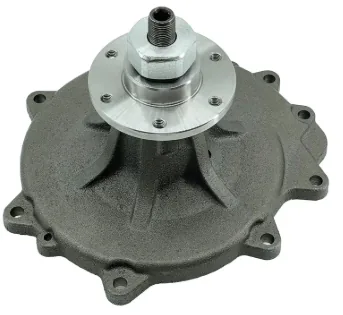
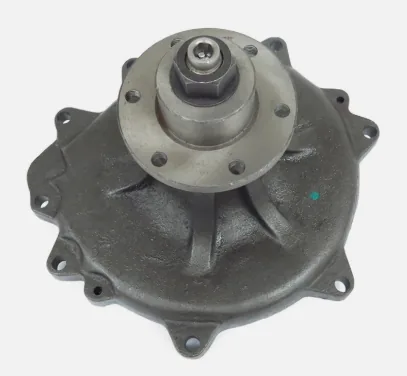
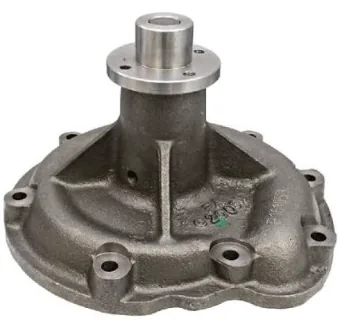
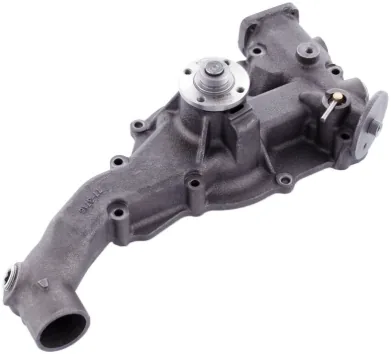
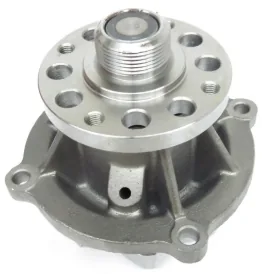
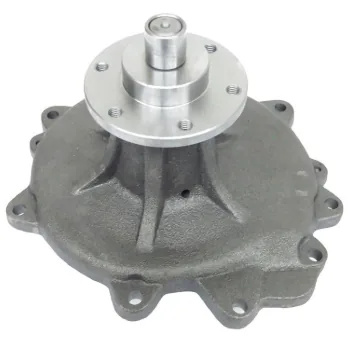
The engine water pump is a critical component of the cooling system. Its primary function is to circulate coolant between the engine water jackets, radiator and other cooling-system components so that the engine can operate within its specified temperature range.
A typical mechanical automotive water pump consists of several key components:
- Pump housing
- Pulley or drive hub
- Shaft
- Water pump bearing
- Mechanical seal
- Impeller
Among these components, the water pump bearing and shaft assembly has a major influence on the service life, vibration, noise and overall reliability of the pump.
A bearing failure can eventually damage the mechanical seal, cause coolant leakage or allow excessive pulley movement. In severe cases, the pump may seize or stop circulating coolant, resulting in engine overheating.
Why Is the Water Pump Bearing So Important?
Many automotive water pumps use an integral shaft bearing, sometimes referred to as a water pump bearing.
Unlike a conventional bearing with a separate inner ring, some water pump bearing designs use the pump shaft itself as the inner raceway.
This compact design provides:
- High radial load capacity
- Good shaft rigidity
- Precise pulley and impeller alignment
- Compact packaging
- Reduced component count
However, because the shaft also performs the function of the bearing raceway, its material quality, heat treatment, surface finish and dimensional accuracy are critical.
Rolling Contact Fatigue in Water Pump Bearings
During operation, the bearing raceways and rolling elements are subjected to repeated contact stresses.
Over a very large number of operating cycles, microscopic fatigue cracks may develop below or near the rolling surface.
As these cracks propagate, small areas of material can eventually separate from the raceway or rolling elements.
This type of damage is known as:
Rolling contact fatigue
or
fatigue flaking / spalling
Once significant flaking occurs, the bearing may develop:
- Increased vibration
- Humming or grinding noise
- Higher operating temperature
- Increased radial play
- Rough rotation
- Reduced bearing life
NSK describes fatigue flaking as a normal rolling-bearing failure mechanism caused by repeated cyclic stress acting on the raceways and rolling elements.
In a water pump, excessive bearing play can also disturb the shaft alignment and place additional load on the mechanical seal.
Eventually this may lead to coolant leakage or complete pump failure.
Water Pump Bearing Materials
High-carbon chromium bearing steels are commonly used for rolling-bearing components because they provide the hardness, wear resistance and rolling-contact fatigue strength required for high-speed operation.
One commonly used Chinese bearing-steel designation is:
GCr15
Comparable international bearing steels include grades such as:
- SAE / AISI 52100
- 100Cr6
- SUJ2
The exact steel grade and heat-treatment specification vary according to the bearing manufacturer and application.
High-quality bearing steel is typically manufactured with strict control over:
- Non-metallic inclusions
- Oxygen content
- Steel cleanliness
- Carbide distribution
- Heat treatment
- Raceway hardness
- Surface finish
Bearing manufacturers also use vacuum-degassed high-purity steel to improve rolling fatigue performance. NSK, for example, identifies steel cleanliness and appropriate heat treatment as important factors affecting bearing fatigue life.
For this reason, material specification alone does not determine water pump bearing quality.
A good water pump bearing also depends on:
Steel quality + heat treatment + grinding accuracy + internal clearance + sealing + lubrication
Water Pump Bearing Construction
Depending on the application, water pump bearings may use different rolling-element arrangements.
Typical configurations include:
- Ball-ball
- Roller-ball
- Double-row ball
- Other application-specific combinations
Water pump bearing manufacturers offer different structures depending on radial load, axial load, shaft length and operating speed. Commercial water-pump-bearing ranges include roller-ball and double-row ball configurations.
For heavy-duty applications, the bearing design must withstand loads generated by components such as:
- Drive belts
- Pulleys
- Fan drives
- Impellers
- Belt tension
Incorrect belt tension can therefore have a direct effect on water pump bearing life.
Bearing Cage and Seal Materials
The internal bearing cage may be manufactured from materials such as:
- Reinforced engineering polymer
- Steel
- Other application-specific materials
Engineering polymers such as reinforced polyamide are commonly used in many automotive bearing applications because of their low mass and good running characteristics.
Bearing seals may use elastomers selected according to temperature, lubricant and operating environment.
Typical elastomer families may include:
- NBR
- HNBR
- FKM
The actual material must be selected according to the bearing manufacturer's design and operating-temperature requirements.
It should therefore not be assumed that every automotive water pump bearing uses the same cage or seal material.
Lubrication Is Critical to Water Pump Bearing Life
Water pump bearings operate under demanding conditions including:
- High rotational speed
- Elevated engine-compartment temperature
- Belt loading
- Continuous vibration
- Long operating periods
The grease inside the bearing therefore has a major influence on service life.
Water pump bearing grease should provide appropriate:
- High-temperature stability
- Mechanical stability
- Oxidation resistance
- Lubricating film strength
- Compatibility with seals
- Long-term retention
Insufficient or degraded lubrication can result in:
- Increased friction
- Higher bearing temperature
- Raceway wear
- Surface damage
- Premature fatigue
- Bearing seizure
Excessive lubricant or an unsuitable lubricant can also affect bearing performance.
The correct grease formulation and quantity should therefore be determined by the bearing design rather than simply using a grease with the highest possible dropping point.
Common Symptoms of Water Pump Bearing Failure
Water pump bearing failure can usually be identified by several characteristic symptoms.
1. Abnormal Noise
A damaged bearing may produce:
- Humming
- Grinding
- Growling
- Squealing
- Rumbling
The noise often changes with engine speed.
As bearing damage becomes more severe, the noise generally becomes more noticeable.
2. Pulley or Shaft Play
A worn bearing can allow the water pump pulley or shaft to move radially.
With the engine stopped and cooled, excessive pulley movement can indicate bearing deterioration.
Excessive shaft play can also damage the mechanical seal.
3. Coolant Leakage
The bearing does not normally seal the coolant directly.
The mechanical seal separates the coolant side of the pump from the bearing.
However, if the bearing becomes worn or develops excessive shaft movement, the mechanical seal may no longer operate correctly.
Coolant may then leak from:
- The pump housing
- The mechanical seal area
- The weep hole
A coolant leak from the water pump weep area is an important indication that the mechanical seal or pump assembly requires inspection.
4. Water Pump Pulley Wobble
Severe bearing wear can cause visible pulley movement.
Pulley wobble may lead to:
- Belt misalignment
- Belt noise
- Uneven belt wear
- Increased belt vibration
- Mechanical seal damage
A visibly wobbling water pump pulley requires immediate investigation.
5. Engine Overheating
If the water pump bearing deteriorates severely enough to damage or seize the pump, coolant circulation may be reduced or completely interrupted.
Possible consequences include:
- Engine overheating
- Coolant boiling
- Temperature warning
- Loss of coolant
- Serious engine damage
The water pump is therefore a relatively small component that can cause very expensive engine damage if failure is ignored.
Common Causes of Water Pump Bearing Failure
1. Excessive Belt Tension
An over-tightened belt places additional radial load on the water pump shaft and bearing.
This can shorten bearing fatigue life.
When replacing a water pump, the condition and adjustment of the belt-drive system should also be checked.
For automatic systems, inspect:
- Belt tensioner
- Idler pulleys
- Belt alignment
- Belt condition
2. Incorrect Pulley Alignment
Pulley misalignment creates abnormal loading on the water pump shaft.
Long-term operation under misalignment can contribute to:
- Uneven bearing load
- Vibration
- Belt wear
- Premature bearing failure
3. Poor Bearing Material or Heat Treatment
Incorrect steel composition, excessive inclusions, inadequate heat treatment or insufficient raceway hardness can reduce rolling contact fatigue life.
Conversely, inappropriate heat treatment can make components excessively brittle.
Bearing quality therefore depends on both the material and the manufacturing process.
4. Stress Concentration in the Shaft
Sharp transitions, machining marks, grooves or unsuitable shaft geometry can create stress concentration.
Under repeated belt and impeller loading, fatigue cracks may initiate in these areas.
Good shaft design normally uses controlled transitions and surface finishing to reduce stress concentration.
5. Lubrication Failure
Premature grease degradation may result from:
- Excessive temperature
- Poor-quality lubricant
- Contamination
- Incorrect grease quantity
- Seal failure
Poor lubrication increases friction and surface stress, accelerating wear and bearing damage.
6. Coolant Contamination
If the mechanical seal fails and coolant reaches the bearing area, the grease and bearing surfaces may become contaminated.
This can rapidly reduce bearing life.
Coolant contamination should therefore be treated as a complete pump problem rather than simply a lubrication issue.
7. Incorrect Installation
Installation errors can also damage the water pump bearing.
Examples include:
- Applying excessive force to the shaft
- Hammering the pulley or hub
- Incorrect bolt tightening
- Misaligned belt installation
- Incorrect belt tension
- Reusing damaged pulleys or tensioners
Some bearing damage begins during installation but does not become noticeable until thousands of kilometres later.
Water Pump Bearing Failure Diagnosis
A basic diagnosis can follow this sequence:
| Diagnostic Check | What to Look For | Possible Cause |
| Listen to pump area | Grinding, growling or humming | Bearing wear or damage |
| Check pulley movement | Excessive radial or axial play | Bearing wear |
| Observe pulley rotation | Wobble or misalignment | Bearing or shaft damage |
| Inspect weep hole | Coolant leakage | Mechanical seal failure |
| Inspect drive belt | Uneven wear or misalignment | Pulley or tension problem |
| Rotate pump manually | Roughness or binding | Internal bearing damage |
| Check engine temperature | Overheating | Reduced coolant circulation |
| Inspect coolant | Contamination or incorrect coolant | Seal or cooling-system problem |
The engine must be switched off and allowed to cool before physically inspecting the pulley, belt or water pump.
Bearing Failure or Mechanical Seal Failure?
These two failures are closely related but should not be confused.
Bearing Failure
Typical indicators include:
- Noise
- Rough rotation
- Shaft play
- Pulley wobble
- Seizure
Mechanical Seal Failure
Typical indicators include:
- Coolant leakage
- Persistent leakage from the weep hole
- Coolant deposits around the pump
- Falling coolant level
One failure can eventually cause the other.
For example:
Bearing wear → shaft movement → mechanical seal damage → coolant leakage
or:
Mechanical seal failure → coolant contamination → bearing damage
For this reason, diagnosing the entire water pump assembly is usually more useful than examining one component in isolation.
Should the Bearing or the Complete Water Pump Be Replaced?
For many modern automotive applications, a failed water pump bearing is normally addressed by replacing the complete water pump assembly.
This is because the bearing, shaft, mechanical seal and impeller operate as an integrated system.
Replacing only one worn component may leave other components close to the end of their service life.
However, this is not an absolute rule.
Some heavy-duty, industrial or rebuildable water pumps are specifically designed to be remanufactured using replacement:
- Bearings
- Shafts
- Mechanical seals
- Impellers
- Other internal components
The correct repair method therefore depends on the particular pump design and the engine manufacturer's service procedure.
Check the Belt Drive When Replacing a Water Pump
A failed water pump may be the result rather than the original cause of the problem.
When replacing a belt-driven water pump, inspect related components including:
- Drive belt
- Belt tensioner
- Idler pulleys
- Water pump pulley
- Fan hub or fan clutch where applicable
- Pulley alignment
If a water pump is driven by a timing belt, the applicable timing-drive components should be inspected or replaced according to the engine manufacturer's service procedure.
Not all water pumps are timing-belt driven. Depending on the engine, the pump may be driven by:
- Serpentine belt
- V-belt
- Timing belt
- Gear drive
- Electric motor
The service procedure must therefore match the specific engine application.
How to Extend Water Pump Service Life
To reduce the risk of premature water pump failure:
- Use the correct coolant specified by the engine manufacturer.
- Maintain the correct coolant concentration and condition.
- Inspect belts and tensioners regularly.
- Avoid excessive belt tension.
- Check pulley alignment.
- Replace damaged idlers and tensioners.
- Do not ignore water pump noise or pulley play.
- Investigate coolant leakage immediately.
- Follow the correct installation procedure.
- Use a water pump with suitable bearing, seal and impeller quality.
Water Pump Quality Is More Than the Housing and Impeller
When comparing replacement water pumps, external appearance alone does not reveal the quality of the product.
Important internal characteristics include:
- Bearing design
- Bearing steel quality
- Raceway heat treatment
- Rolling-element quality
- Shaft dimensional accuracy
- Grease specification
- Bearing sealing
- Mechanical seal quality
- Impeller design
- Dynamic balance
Because bearing and mechanical seal performance directly affect pump durability, these components are critical when evaluating the quality of an aftermarket water pump.
Looking for a Replacement Heavy-Duty Water Pump?
To identify the correct replacement water pump, provide:
- OE part number
- Truck make and model
- Engine manufacturer
- Engine model
- Engine serial number if available
- Vehicle year
- Photos of the original pump
This information can be used to cross-reference the application and identify the correct replacement water pump.